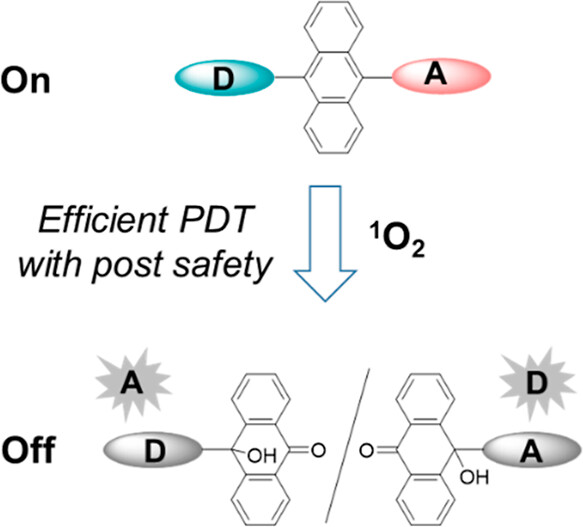
A photosensitizer designed to deactivate itself. An anthracene bridge links the donor and acceptor. Singlet oxygen produced during illumination also reacts with the bridge, connecting photosensitization to molecular breakdown. Diagram · Jucai Gao et al., Chemistry of Materials. Paper and figure context.
Abstract
Photodynamic therapy (PDT) is a minimally invasive therapeutic modality. However, the residual photosensitizers (PSs) after PDT can still produce toxic singlet oxygen (1O2) under sunlight to damage normal tissues. The PS that can be switched off after PDT is desirable but rare. Herein, we propose a general strategy to design effective and self-degradable PSs by embedding an anthracene bridge into donor–acceptor (D–A) structures. First, the steric anthracene can regulate the orbital distribution for enhancing the 1O2 production capacity. More importantly, the anthracene is responsive to the self-produced 1O2 for self-degradation. Besides, the degradation rate can be fine-tuned by the hydrophilicity of PSs. In this way, the PSs can realize a balance between treatment and suicide to ensure PDT and post-treatment safety. This work provides new insights into the design of degradable PSs with a clear mechanism, aiming to improve the post-safety of PDT.