Article-Journal

Photophysics of an Asymmetric Donor–Acceptor–Donor′ TADF Molecule and Reinterpretation of Aggregation-Induced TADF Emission in These Materials
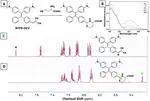
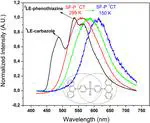
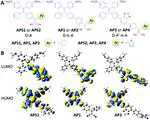
We report an in-depth photophysical investigation of an asymmetric donor–acceptor–donor′ (D–A–D′) thermally activated delayed fluorescence (TADF) molecule (4-(9H-carbazol-9-yl)phenyl)(4-(10H-phenothiazin-10-yl)phenyl)sulfone and compare its photophysical properties to the parent symmetric D–A–D and D′–A–D′ molecules. These D–A–D type small molecules all show strong TADF. The work reveals how the relative orientations of D–A (D′–A) moieties favor reverse intersystem crossing (rISC) by forming stable charge transfer (CT) states. The key requirement for the efficient TADF emitters is to achieve a very small CT-local triplet state energy splitting, which is shown to be complex in the asymmetric molecule. Throughout the investigations, we show that in the asymmetric D–A–D′ system, even though ECT (D–A) > ECT (D′–A), no evidence of energy transfer from D–A to A–D′ is observed, nor from excited D to D′. This is ascribed to the near orthogonality of the D and D′ units and the very strong decoupling of the electrons on the D and A in the CT state. In addition, the possibility of aggregation-induced TADF (AI-TADF) is examined and shown to be a manifestation of solvatochromism in these particular molecules.
Photophysics of an Asymmetric Donor–Acceptor–Donor′ TADF Molecule and Reinterpretation of Aggregation-Induced TADF Emission in These Materials
Rational Design of a Red-Emissive Fluorophore with AIE and ESIPT Characteristics and Its Application in Light-Up Sensing of Esterase
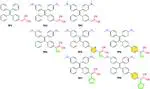
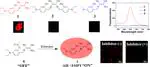
The development of red fluorophores with efficient solid-state emission is still challenging. Herein, a red fluorophore 1 with aggregation-induced emission (AIE) and excited-state intramolecular proton transfer (ESIPT) characteristics is rationally designed and facilely synthesized by attaching an electron-donor diethylamine and an electron-acceptor maleonitrile group to salicyladazine. In contrast to many red fluorophores which undergo serious aggregation-caused quenching (ACQ), compound 1 emits bright red fluorescence (λem = 650 nm, ΦF = 24.3%) in the solid state with a large Stokes shift of 174 nm. Interestingly, control compounds 2 and 3, which have similar structures as 1, exhibit obvious aggregation-caused quenching (ACQ) characteristics. The difference in the crystal structures of 1, 2, and 3 reveals that the interplanar spacing among molecules plays a decisive role in realizing the AIE characteristics of 1. Moreover, when the hydroxyl group of 1 was substituted by an esterase reactive acetoxyl, a fluorescence light-up probe 4 was developed for sensing of esterase based on the selective reaction between 4 and esterase to generate the AIE and ESIPT active molecule 1. The linear range for in vitro quantification of esterase is 0.01–0.15 U/mL with a detection limit of 0.005 U/mL. Probe 4 was also successfully applied to image esterase in mitochondria of living cells.
Rational Design of a Red-Emissive Fluorophore with AIE and ESIPT Characteristics and Its Application in Light-Up Sensing of Esterase